
Yes, Google can rank AI-generated content if it is helpful, accurate, original, and created for people instead of search engines. Google has repeatedly stated that it evaluates the quality of content rather than the method used to create it. Whether an article is written by a person, AI, or a combination of both, it must provide real value to readers.
However, relying on AI alone is rarely enough. Human review, fact-checking, and unique insights remain essential for producing content that performs well in search results. Understanding Google’s approach to AI-generated content can help you use AI responsibly while improving your chances of ranking.
Google’s Official Position on AI-Generated Content
Understanding Google AI content policy explained starts with one important fact: Google has never said AI-generated content is automatically against its guidelines.
Instead, Google focuses on the quality and usefulness of the final content. According to Google Search Essentials, the goal is to reward content that genuinely helps users answer their questions, regardless of whether it was written by a human or created with AI assistance.
Google treats AI as a productivity tool rather than a ranking factor. Just as writers use grammar checkers, research tools, or content editors, AI can assist with brainstorming, drafting, and organizing ideas. What matters is whether the finished article demonstrates expertise, accuracy, and originality.
This approach aligns with Google’s E-E-A-T framework:
- Experience: Shows first-hand knowledge or practical insights.
- Expertise: Demonstrates subject knowledge.
- Authoritativeness: Establishes credibility through the provision of reliable information.
- Trustworthiness: Provides accurate, transparent, and dependable content.
When AI-generated content lacks these qualities, it becomes less competitive regardless of how it was produced.
Does Google Penalize AI Content?
One of the biggest misconceptions in SEO is that Google automatically penalizes articles written by AI. The reality is much different.
The answer to whether Google penalizes AI content is no, not simply because AI was involved. Google only takes action when content violates its spam policies or provides little value to users.
Some examples include:
- Publishing thousands of low-quality pages generated without human review.
- Copying or slightly rewriting existing articles.
- Creating keyword-stuffed pages solely to manipulate rankings.
- Publishing inaccurate or misleading AI-generated information.
- Producing thin content that fails to answer user intent.
In other words, poor-quality content is the problem, not artificial intelligence itself.
Many websites successfully use AI to speed up drafting while relying on subject matter experts to review, improve, and verify every article before publication. This combination often produces better results than relying entirely on manual writing or fully automated generation.
AI Content vs Helpful Content Update

Many people believe Google’s Helpful Content Update specifically targeted AI-generated articles, but that’s not the case. The update focuses on rewarding content that genuinely helps users.
The difference is easier to understand in the comparison below.
| Helpful Content | Poor AI Content |
| Provides original insights | Repeats existing information |
| Fact-checked and accurate | Contains AI hallucinations |
| Reviewed by humans | Published without editing |
| Solves user problems | Focuses only on keywords |
| Demonstrates expertise | Lacks depth and authority |
The discussion around AI content vs Helpful Content Update often misses one important point: Google’s systems evaluate whether readers find the content useful, not whether AI assisted in writing it.
An AI-assisted article that includes expert opinions, updated statistics, practical examples, and thorough editing is far more likely to perform well than a generic article written entirely by a person.
The Helpful Content System rewards pages that satisfy search intent, answer questions completely, and offer information users cannot easily find elsewhere.
Understanding Google’s Scaled Content Abuse Policy
Another important concept is Google’s scaled content abuse policy, which became a major topic after Google’s updates to its spam policies.
Scaled content abuse refers to producing large amounts of low-value content primarily to manipulate search rankings. This policy applies regardless of whether the content is created by AI, humans, or a combination of both.
Examples include:
- Automatically generating hundreds of nearly identical pages.
- Publishing location pages with only minor wording changes.
- Creating thousands of product descriptions without adding useful information.
- Using AI to mass-produce articles with little or no editorial review.
It is important to understand that the policy does not ban AI. Instead, it targets large-scale production of low-quality content designed to exploit search rankings.
Human-written spam can violate these policies just as easily as AI-generated spam.
If your content is original, well-researched, and reviewed before publication, using AI as part of your workflow is generally consistent with Google’s guidance.
Factors That Help AI Content Rank
Publishing AI-generated content is only the first step. Ranking depends on how well the content meets user expectations and Google’s quality standards.
The following factors consistently improve the ranking potential of AI-assisted articles:
- Add original research, examples, or case studies.
- Include first-hand experience whenever possible.
- Review and verify every factual statement.
- Update statistics and references regularly.
- Optimize headings to match search intent.
- Improve readability with short paragraphs and descriptive subheadings.
- Use relevant internal links to supporting resources.
- Include original visuals, screenshots, or diagrams.
- Strengthen E-E-A-T with author information and credible references.
- Focus on solving the reader’s problem instead of simply targeting keywords.
When these best practices are followed, AI becomes a valuable assistant rather than a shortcut for creating content.
Common Reasons AI Content Fails to Rank
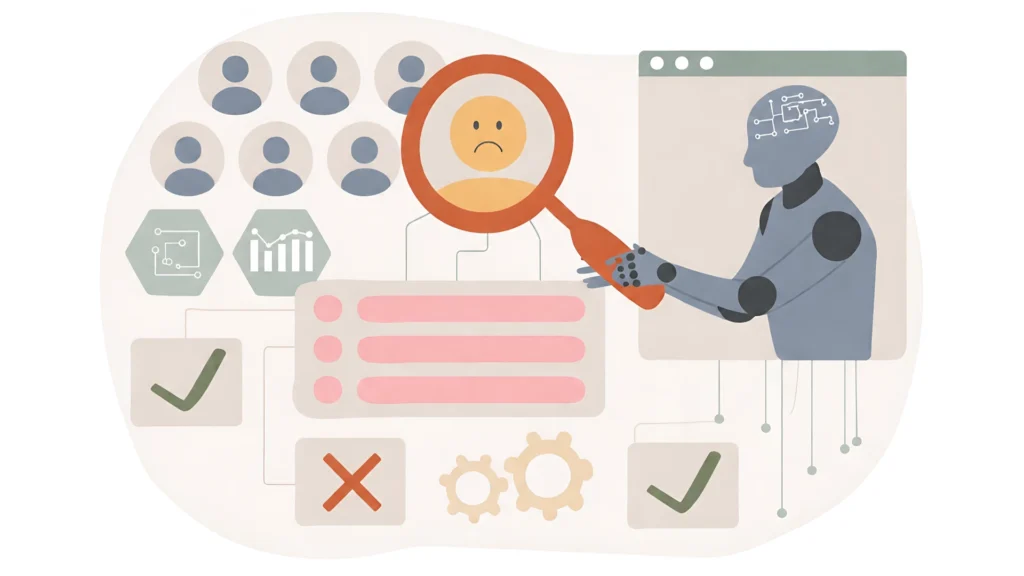
Although AI-generated content can rank, many AI-written articles fail because they prioritize speed over quality. Google’s algorithms are designed to reward content that demonstrates expertise, satisfies search intent, and provides genuine value. If your content lacks these qualities, it may struggle to perform regardless of whether it was written by AI or a human.
Here are the most common reasons AI-assisted content fails to rank:
- Lack of originality: Simply rewriting existing articles adds little value for readers.
- AI hallucinations: Incorrect facts, statistics, or references reduce trustworthiness.
- Weak E-E-A-T: Articles without experience, expertise, or credible sources often underperform.
- Thin content: Short, surface-level articles fail to answer users’ questions completely.
- Duplicate or repetitive information: Publishing similar content across multiple pages can weaken SEO performance.
- Keyword stuffing: Overusing keywords makes content difficult to read and may signal spam.
- No supporting evidence: Claims without examples, research, or citations appear less credible.
- Poor formatting: Large blocks of text, missing headings, and unclear structure reduce readability.
The takeaway is simple: AI should help improve efficiency, not replace quality. Every article should be reviewed and enhanced before publication.
Best Practices for Publishing AI-Assisted Content
Using AI responsibly can save time while maintaining high content standards. The most successful publishers treat AI as a writing assistant rather than a complete replacement for human expertise.
A practical workflow includes the following steps:
- Use AI to create the first draft and organize ideas quickly.
- Add expert knowledge that reflects your own experience or research.
- Fact-check every statement using reliable and up-to-date sources.
- Rewrite repetitive or generic sections to make them more engaging.
- Include real examples that help readers understand the topic.
- Create original visuals such as charts, screenshots, or infographics.
- Optimize headings with descriptive, keyword-focused titles.
- Add relevant internal links to related articles on your website.
- Include an author bio to strengthen E-E-A-T signals.
- Review and update the article regularly as Google’s guidance and SEO best practices evolve.
This workflow combines AI’s efficiency with human judgment, resulting in content that is more accurate, trustworthy, and valuable for readers.
AI Content vs Human Content: Which Performs Better?
There is no universal winner between AI-generated and human-written content. Each has its own strengths and limitations.
| AI Content | Human Content |
| Produces drafts quickly | Takes longer to create |
| Speeds up content production | Offers stronger storytelling |
| Cost-effective for scaling | Provides deeper personal insights |
| Requires careful editing | Naturally reflects experience |
| Can rank with proper optimization | Can also rank with quality and relevance |
In practice, the best-performing articles are often created through AI-assisted, human-edited workflows. AI helps improve productivity, while human expertise ensures originality, accuracy, and trustworthiness.
FAQs
Google has not stated that it relies on AI detection tools to identify AI-generated content. Instead, its ranking systems evaluate content based on quality, relevance, originality, and usefulness. Even if AI is used during the writing process, helpful content that meets Google’s quality standards can still rank well.
Google does not require websites to disclose AI-generated content. However, if AI is used in situations where transparency is important, such as medical, financial, or legal content, explaining your editorial process can help build trust with readers.
AI-generated content is not inherently bad for SEO. It can improve productivity and content creation when combined with human editing, fact-checking, and original insights. Problems arise only when AI is used to publish low-quality or spammy content at scale.
Yes, AI-assisted content can rank without a large number of backlinks if it satisfies search intent, targets low-competition keywords, and demonstrates strong E-E-A-T. However, earning high-quality backlinks can significantly improve visibility for competitive search terms.
The most effective approach is to use AI for research, brainstorming, outlining, and drafting while relying on human expertise for editing, fact-checking, adding unique insights, and optimizing the content for readers. This hybrid workflow produces higher-quality articles that align with Google’s recommendations.