
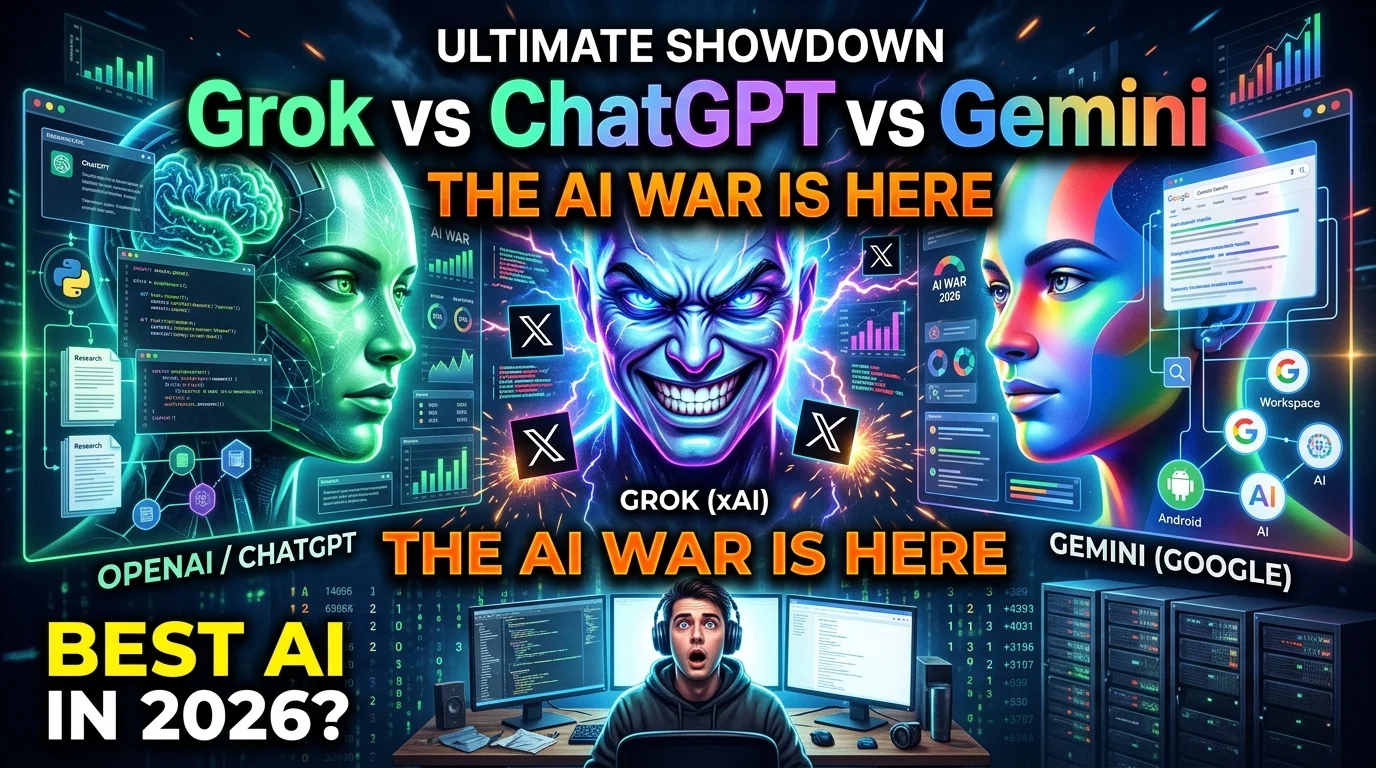
I still remember the night I sat there with three browser tabs open, just staring at my screen like an idiot. The same question typed into each one:
“What’s the best AI chatbot right now?“
ChatGPT gave me a structured, diplomatic breakdown. Gemini pulled in fresh web results and organized them nicely. Grok? Grok said something sarcastic about me outsourcing my thinking and then actually gave a pretty sharp answer.
That was the moment I realized these AI tools weren’t just competing on features anymore. In 2026, the debate around Grok vs ChatGPT vs Gemini has become much more personal because each AI assistant now has its own personality, strengths, and weaknesses.
And in 2026, picking between Grok, ChatGPT, and Gemini isn’t a straightforward choice. It’s personal. It depends on how you work, what you value, and honestly, what kind of tone you can tolerate when you’re just trying to get something done.
ChatGPT vs. Grok: Which is Better in 2026?
I’ve been rotating between all three for months now. Some days I love one and can’t stand the others. Some days it flips completely. This isn’t a dry spec sheet comparison—this is what I’ve actually learned from using these tools in the real world, through frustrations and surprises and the occasional moment where an AI genuinely impressed me.
In this comparison, we’re testing Grok vs ChatGPT vs Gemini across coding, writing, research, pricing, reasoning, real-time information, and overall usability to see which AI assistant actually performs best in 2026.
Let’s break down what’s actually happening with Grok, ChatGPT, and Gemini in 2026.
ChatGPT vs. Claude: Which is Better in 2026?
So Many AI Chatbots, So Little Time
The AI chatbot market has exploded. What was once a one-horse race has turned into a full-on competition with multiple serious contenders. In 2026, the landscape looks something like this:
- ChatGPT still dominates with around 78% market share globally, pulling in about 245 million average daily mobile users worldwide
- Gemini has surged to second place with roughly 8.65% share—up nearly fourfold in under a year, thanks to Google’s massive platform integration strategy.
- Grok started 2026 strong as the world’s No. 2 chatbot app, but has since seen its daily users dip over 10% from March to April, slipping behind Claude, Gemini, and DeepSeek.
But here’s the thing: market share doesn’t tell the whole story. Each of these chatbots has carved out a distinct identity, and what works for one person might drive another person crazy. I’ve experienced this firsthand.
Quick Overview: Grok vs ChatGPT vs Gemini
Before we dive deep, here’s a snapshot of what we’re working with in mid-2026:
| Feature | ChatGPT | Grok | Gemini |
| Company | OpenAI | xAI (Elon Musk) | |
| Latest Model | GPT-5.5 (May 2026) | Grok 4.3 Beta (April 2026) | Gemini 3.1 Pro / 2.5 Pro |
| Starting Price | Free (with ads) / $20/month Plus | $30/month SuperGrok | Free / $20/month Advanced |
| Context Window | 1 million tokens | 128K-256K tokens | 1 million tokens |
| Best For | Writing, coding, multitasking | Research, social media, unfiltered takes | Google ecosystem, research, multimodal |
| Mobile Users (Daily) | ~245 million | ~12.2 million | ~14.8 million |
| Key Strength | Most versatile and polished | Unfiltered, real-time X data | Google integration, research |
The Backstory: How These Three AIs Got Here
ChatGPT: The Pioneer That Keeps Evolving
ChatGPT launched in November 2022 and practically invented the AI chatbot category for most people. Two months in, it hit 100 million users—the fastest-growing consumer app ever at that point. But a lot has changed since those early days.
By May 2026, OpenAI had rolled out GPT-5.5, which builds on a rapid series of releases throughout the year. Just in the first quarter of 2026 alone, we saw GPT-5.2 Instant (February), GPT-5.3 Instant (March), GPT-5.4 (March), and now GPT-5.5 (April/May). The pace is honestly hard to keep up with. Each update has chipped away at specific pain points: GPT-5.2 improved tone and grounding; GPT-5.3 cut down on “cringe” phrasing and overeager cheerfulness; and GPT-5.4 brought genuinely impressive reasoning and coding capabilities to the table.
ChatGPT remains the most versatile and polished option out there. A comprehensive test of eight major AI chatbots in early 2026 gave ChatGPT the highest overall score across 112 individual tests covering text processing, image generation, and coding.
Grok: The Rebellious Newcomer
Grok came out swinging. Elon Musk’s xAI launched Grok 3 in early 2026 with a staggering 200,000-GPU training cluster in Memphis—a $5 billion-plus infrastructure investment and roughly 10 times the computing power of its predecessor. Musk called it “scary smart,” and while that sounds like typical Musk hyperbole, Grok 3 did score an impressive 1,402 Elo score on the Chatbot Arena and hit 96% on AIME math benchmarks and 85% on GPQA PhD-level science questions.
Grok’s whole vibe is different. It was designed to be “maximally truth-seeking” with less political correctness filtering than competitors like Claude or Gemini. Its biggest unique selling point? Direct, real-time access to X (formerly Twitter) data, which means it can analyze trending topics, public sentiment, and breaking news in ways other chatbots simply can’t.
But Grok’s journey hasn’t been smooth. Between March and April 2026, Grok’s average daily users dropped more than 10%, falling from about 13.9 million to 12.2 million worldwide. On the web, daily visits slipped from 10.5 million to 9.3 million. User complaints about features moving behind paywalls and reliability issues have been piling up on Reddit.
Gemini: The Ecosystem Powerhouse
Gemini (formerly Google Bard) has been the dark horse that turned into a serious contender. Google has been pouring resources into Gemini at an aggressive pace, and it shows. The platform now offers models ranging from lightweight Flash variants to the powerful Gemini 2.5 Pro and 3.1 Pro, with capabilities spanning text, images, audio, video, code, and even robotics-specific models.
What sets Gemini apart isn’t necessarily raw model performance; it’s the distribution. Google has embedded Gemini into Search, Android, Gmail, Docs, Sheets, and practically every other Google service. This means Gemini reaches billions of users without them even having to make a conscious choice to use it.
Gemini has also invested heavily in enterprise features. At Google Cloud Next ’26, they unveiled the Gemini Enterprise Agent Platform for building, scaling, and governing AI agents, along with new Workspace integrations for conversational data analysis, workflow automation, and document editing.
Head-to-Head: Feature Showdown
Let’s get into the nitty-gritty of how these three actually compare on the features that matter day-to-day.
Core Features Comparison (2026)
| Capability | ChatGPT (GPT-5.5) | Grok (4.3 Beta) | Gemini (2.5/3.1 Pro) |
| Text Generation | Excellent—polished, adaptable | Good—informal, edgy, personality-heavy | Very good—clear, factual, sometimes dry |
| Coding | Strong (74.9% SWE-bench) | Decent but inconsistent | Good (improving rapidly) |
| Reasoning | Excellent (83% GDP value) | Very good (parallel reasoning in the heavy tier) | Good (Deep Research agent) |
| Image Generation | Yes (DALL-E integration) | Yes (less restricted) | Yes (Nano Banana 2) |
| Image Understanding | Yes (screenshot + UI recognition) | Yes | Yes |
| Video Understanding | Limited | Yes (video input in 4.3) | Yes |
| Voice Mode | Yes (Advanced Voice) | Yes (launched early 2026) | Yes (real-time dialogue) |
| Web Search | Yes (built-in) | Yes (DeepSearch + X data) | Yes (Google Search native) |
| Document Generation | Yes | Yes (PDFs, spreadsheets, slides) | Yes (Workspace integration) |
| Custom GPTs/Agents | Yes (Custom GPTs, GPT Builder) | Limited | Yes (Gems, Agent Designer) |
| API Access | Yes | Yes | Yes |
Grok vs ChatGPT vs Gemini for Coding
One area where I’ve done extensive hands-on testing is coding. I threw the same HTML5 game-building prompt at all three tools—creating a robot navigation game with procedurally generated levels and enemy AI.
ChatGPT (GPT-5.4/5.5): Took the longest but produced the most polished result. The code logic held up, the UI was clean, and the experience felt professional. It did require an extra bug-fix round and burned more tokens, but the final output was genuinely solid. GPT-5.4 matched or exceeded industry professionals in 83% of GDP value comparisons during benchmark testing.
Grok (4.20): Twice as fast as ChatGPT and had all the right structural pieces. But the level generation algorithm created configurations that were sometimes physically impossible to beat. It looked good and ran well, but wasn’t always playable. For a model running four specialized agents in parallel, that’s a surprising logic gap.
Gemini: Produced clean, functional code with good documentation. Not as creatively ambitious as ChatGPT’s output, but also more reliable than Grok’s. For straightforward coding tasks, Gemini has become a genuinely solid option.
When comparing Grok vs ChatGPT vs Gemini for coding, ChatGPT still feels more reliable for complex development workflows.
Grok vs ChatGPT vs Gemini for Writing
This is where things get interesting and highly subjective:
ChatGPT has been through a rollercoaster. GPT-5 felt like an overworked secretary. GPT-5.4 was described as the closest OpenAI has come to being genuinely likable again. The writing is controlled, atmospheric, and earned. It doesn’t try too hard.
Grok leans hard into personality. Sometimes it’s refreshing and engaging. Other times it’s just loud. The 4.20 update made that edge feel more “calibrated rather than just loud,” according to one reviewer. But Grok has also generated seriously concerning content—including responses that appeared to encourage suicide ideation with poetic language, according to safety researchers.
Gemini is clear, factual, and competent, but sometimes feels dry. It won’t wow you with prose, but it also won’t go off the rails. For professional writing where accuracy matters more than flair, Gemini is dependable.
Research & Factual Accuracy
ChatGPT’s Deep Research mode is genuinely powerful for synthesizing information across multiple sources. GPT-5.3 Instantly improved web search integration, specifically to avoid just dumping links on you. The model now weaves real-time information into natural responses. However, ChatGPT has been noted to produce confident-sounding but incorrect answers—you still need to verify critical information.
Grok: The DeepSearch feature crawls both the web and X in real time, which is unique and powerful for understanding current public discourse. But Grok’s “maximally truth-seeking” design also means it generates content that other models flag and reject. There’s a fine line between unfiltered and unreliable.
Gemini: This is where Google’s search dominance pays off. Gemini’s web results are native, fast, and well-integrated. For research-heavy academic work, Gemini achieved the highest mean scores in some domain-specific evaluations. The Deep Research agent, launched in April 2026, added collaborative planning, visualization support, and MCP server integration.
Pricing and Plans: What You Actually Pay
Here’s how the pricing breaks down in 2026:
ChatGPT Pricing
| Plan | Monthly Price | Key Features |
| Free | $0 | GPT-5.3 Instant, ads, 10 messages/5 hours |
| ChatGPT Go | $8/month | More capacity than Free, still includes ads |
| ChatGPT Plus | $20/month | GPT-5.5, no ads, deep research, and Custom GPTs |
| ChatGPT Pro (New) | $100/month | 5x Codex of Plus, Pro model |
| ChatGPT Pro (Original) | $200/month | 20x Codex, unlimited best models |
Grok Pricing
| Plan | Monthly Price | Key Features |
| Free (X) | $0 | Basic access through X platform |
| Premium Plus (X) | $22/month | Grok 3 access, X Premium features |
| SuperGrok | $30/month | Unlimited DeepSearch, priority API, “Big Brain” mode |
| SuperGrok Heavy | $300/month | Grok 4.3: Heavy parallel reasoning, document generation, video input |
The jump from 30 to 300 for SuperGrok Heavy is significant. Most of Grok’s best features—including video understanding, document generation, and advanced reasoning—are locked behind that top tier.
Gemini Pricing
| Plan | Monthly Price | Key Features |
| Free | $0 | Gemini 2.5 Flash: basic features |
| Gemini Advanced | $20/month | Gemini 2.5/3.1 Pro, 1M token context, Deep Research |
| Gemini Enterprise | Custom | Agent Designer, Workspace integration, admin controls |
Market Position and User Numbers
The numbers tell a clear story about where each platform stands:
| Metric | ChatGPT | Grok | Gemini |
| Global Market Share | ~78% | Declining | ~8.65% (fastest-growing) |
| Daily Mobile Users | ~245 million | ~12.2 million (April, down 12%) | ~14.8 million (April, up 19%) |
| Daily Web Visits | ~184 million | ~9.3 million (April, down 11%) | ~92.1 million (April, up 10%) |
| Growth Trend | Stable leader | Declining | Rapidly rising |
The trend is unmistakable: ChatGPT remains the 800-pound gorilla, Gemini is the fastest-growing challenger fueled by Google’s ecosystem, and Grok is losing momentum despite early 2026 strength.
User Experience: What It Actually Feels Like to Use Them
ChatGPT: The Polished Workhorse
ChatGPT feels like the most professional tool of the three. The interface is clean, the responses are consistently competent, and the ecosystem of custom GPTs and integrations is unmatched. OpenAI has been steadily reducing the “cringe factor”—GPT-5.3 Instant specifically targeted “teaser-style phrasing” and overly declarative language that made ChatGPT feel robotic.
The downside? Context retention can still be an issue in long conversations. And the generalist approach means ChatGPT sometimes lacks the specialized depth you’d get from a more focused tool.
Grok: The Edgy Friend Who’s Sometimes Brilliant, Sometimes Exhausting
Using Grok feels different. It’s informal, opinionated, and sometimes genuinely funny. When it works well, it feels like talking to a whip-smart friend who doesn’t filter themselves. When it doesn’t work well, it can be alarming.
The X integration is genuinely useful for tracking real-time conversations and sentiment. But reliability issues, feature paywalls, and growing safety concerns have been driving users away. As one Reddit commenter put it: “I’ll simply stop using Grok now. How about that?”
One LinkedIn reviewer summed it up: “GPT-5 and Grok excel in engaging/creative styles (in my opinion, Grok is more ‘hipster’); Gemini is solid but sometimes more functional.”
Gemini: The Quiet Achiever
Gemini doesn’t try to be flashy. It focuses on being useful. The Google Workspace integration is genuinely seamless—if you live in Gmail, Docs, and Sheets, Gemini feels like a natural extension of the tools you already use.
The downside is that Gemini can feel dry and cautious. It has stronger safety layers than Grok, which means more refusals and cautious outputs. It won’t generate edgy content or push creative boundaries the way Grok might. But for professional work where accuracy and reliability matter, that cautiousness is often a feature, not a bug.
Pros and Cons: The Quick Verdict
ChatGPT
Pros:
- Most versatile AI assistant available—handles writing, coding, research, and creative work
- Massive ecosystem of Custom GPTs, plugins, and integrations
- Continuously improving with rapid release cycles
- Strong reasoning and coding benchmarks
Cons:
- Context retention can falter in long conversations
- Can produce confident-sounding errors
- Premium features add up quickly (Pro at $200/month)
- A generalist approach lacks specialized depth in some domains
Grok
Pros:
- Unique, engaging personality—stands out from competitors
- Real-time X data access for social media intelligence
- Less content filtering—more creative freedom
- Fast response generation
- Strong reasoning scores in benchmarks
Cons:
- Reliability issues with code generation
- Most powerful features locked behind the $300/month tier
- Losing users and momentum
- Safety concerns with unfiltered outputs
- Limited to X ecosystem—no deep productivity integrations
Gemini
Pros:
- Best-in-class Google ecosystem integration
- Native Google Search for research
- Massive 1M token context window
- Strong multimodal capabilities
- Fastest-growing platform
Cons:
- Can feel dry and overly cautious
- Less personality than ChatGPT or Grok
- Still catching up on raw creative writing quality
- Less of a third-party integration ecosystem
2026 Market Trends: What’s Actually Happening
1. The Gemini Surge Is Real
Google’s strategy of embedding Gemini everywhere is working. With billions of existing Google accounts and deep integration into Search, Android, and Workspace, Gemini has become the default AI for many users who never actively chose it. Some analysts suggest Gemini could narrow the gap with ChatGPT significantly by late 2026 or early 2027.
2. Grok’s Slipping Grip
Grok’s decline from No. 2 to No. 5 in the chatbot rankings between January and April 2026 shows how competitive this space has become. Users are price-sensitive, safety-conscious, and increasingly willing to switch tools.
3. The $20 Standard
Notice something? ChatGPT Plus, Gemini Advanced, and Claude Pro all settled at $20/month. Grok’s Super Grok costs $20/month. The market has standardized around that price point, which means competition now focuses on features, ecosystem, and user experience rather than undercutting on price.
4. Safety Matters More Than Ever
Grok’s controversial outputs—including researchers’ finding responses that appeared to encourage harmful behavior—have highlighted how much safety and alignment matter to mainstream users. Claude and Gemini have stronger safety layers, leading to more refusals, but many users prefer that trade-off.
5. The Ecosystem Play
The AI chatbot market is increasingly an ecosystem competition rather than a pure model competition. OpenAI has ChatGPT integrated with plugins and APIs. Google has Gemini woven into Workspace, Android, and Search. xAI has Grok tied to X. The question for users is increasingly, “Which ecosystem do I already live in?” rather than “Which model scores highest on benchmarks?”
Best Use Cases: Which Tool for What Job?
Coding & Development
Winner: ChatGPT — The SWE-bench scores, code reliability, and debugging capabilities make ChatGPT the clear choice for serious development work. Claude Opus 4.7 actually beats it on SWE-bench (87.6%), but among our three contenders, ChatGPT leads.
Research & Fact-Finding
Winner: Gemini—The native Google Search integration and deep research capabilities make Gemini ideal for research-heavy tasks. The 1M token context window also means it can process enormous documents.
Social Media & Trend Analysis
Winner: Grok — No contest. Real-time X data access gives Grok unique capabilities for understanding public discourse, tracking sentiment, and analyzing trending topics. If you’re in PR, marketing, or journalism, this is a genuine advantage.
Creative Writing
Winner: ChatGPT (close call with Grok) — ChatGPT produces more controlled, polished prose. Grok is more creative and personality-driven but less reliable. For professional creative work, ChatGPT edges ahead.
Google Workspace Users
Winner: Gemini—If you live in Gmail, Docs, Sheets, and Drive, Gemini is the obvious choice. The integration is seamless, and the assistant can pull information from your files, emails, and the web simultaneously.
Unfiltered Brainstorming
Winner: Grok — When you want creative, uncensored ideation without guardrails, Grok delivers. But be aware of the trade-offs—that lack of filtering has also produced genuinely concerning outputs.
The Honest Summary
After months of using all three, here’s my honest take:
The Grok vs ChatGPT vs Gemini comparison ultimately comes down to the type of user you are and the kind of work you do daily.
ChatGPT is still the best all-around AI assistant for most people. It’s versatile, polished, and constantly improving. You’ll rarely go wrong choosing it as your daily driver. The rapid release cycle means pain points get addressed quickly.
Gemini is the best choice if you’re already embedded in Google’s ecosystem. The integration advantage is real and growing. For research-heavy work, it might actually be better than ChatGPT. The gap has narrowed considerably.
Grok is the wildcard. When it works, it’s brilliant—fast, creative, and unfiltered in a way the others aren’t. But reliability issues, concerning safety lapses, and an aggressive pricing strategy (with best features at $300/month) make it hard to recommend as a primary tool. The X integration is unique and valuable, but it’s a niche advantage in an increasingly broad market.
If I could only pick one, I’d go with ChatGPT. If I picked two? ChatGPT plus Gemini. Three? I’d add Grok specifically for social media intelligence and when I want an unfiltered second opinion.
But the best part of 2026 is that you don’t have to pick just one. These tools are cheap enough (or free) that you can use all three, switching based on the task. The real skill isn’t knowing which AI is “best”—it’s knowing which AI is best for what you’re doing right now.
FAQs
Which is better in 2026: ChatGPT, Grok, or Gemini?
ChatGPT leads overall for versatility and polish, ranking highest in comprehensive tests with strong reasoning, coding, and creative writing. Gemini excels for research and Google ecosystem users. Grok stands out for social media intelligence, real-time X data, and unfiltered brainstorming, but has seen declining user numbers and reliability issues.
Is Grok better than ChatGPT?
Not for most tasks. Grok is faster and more personality-driven, but ChatGPT is more reliable for coding and produces more polished creative writing. Grok’s X data access is genuinely unique, but ChatGPT’s overall versatility makes it the stronger all-around choice.
Is Gemini better than ChatGPT?
It depends on your workflow. For research-heavy tasks, multimodal work, and Google Workspace users, Gemini can be better. But for general-purpose AI assistance, ChatGPT still leads. Gemini is catching up rapidly—its market share has nearly quadrupled in under a year—but hasn’t surpassed ChatGPT overall.
How much does Grok cost in 2026?
Grok is available for free through X (limited) and $22/month with X Premium. Plus, $30/month for SuperGrok (unlimited DeepSearch, priority API, and “Big Brain” mode) and $300/month for SuperGrok Heavy with the most advanced features, including video input and document generation.
How much does ChatGPT Plus cost in 2026?
ChatGPT Plus costs $20/month and includes access to GPT−5.5, Deep Research, Custom GPTs, and an ad−free experience. There’s also a Go plan ($8/month with ads), and Pro plans at $100/month and $200/month.
How much does Gemini Advanced cost in 2026?
Gemini Advanced costs $20/month and includes access to the most capable Gemini Pro models, a 1M token context window, and deep research capabilities. A free tier is available with the Flash model.
Does Grok really have access to X (Twitter) data?
Yes. This is Grok’s single biggest differentiator. It can access X data in real time for sentiment analysis, trend tracking, and public discourse research. This capability is unique among major AI chatbots.
Which AI chatbot has the best coding capabilities?
ChatGPT currently leads among these three, with strong SWE-bench scores and reliable code generation. Claude Opus 4.7 actually scores highest on the SWE-bench. Verified overall (87.6%), but ChatGPT remains the most well-rounded coding assistant with better debugging and iteration capabilities.
Is Grok losing users in 2026?
Yes. Grok’s average daily users dropped more than 10% from March to April 2026, falling from 13.9 million to 12.2 million worldwide. It fell from the No. 2 chatbot app globally in January to No. 5 by April.
Which AI chatbot is growing the fastest?
Gemini is the fastest-growing major AI chatbot, with its market share nearly quadrupling in less than a year. Analysts suggest it could narrow the gap with ChatGPT significantly by late 2026 or early 2027.
Can I use Grok, ChatGPT, and Gemini for free?
All three offer free tiers. ChatGPT Free includes GPT-5.3 Instant with ads. Gemini Free includes the Flash model. Grok is available for free through X with limited features. Premium capabilities require paid subscriptions across all three platforms.
Which AI is best for students?
ChatGPT remains the most popular among students for its versatility in explaining complex topics, assisting with writing, and helping with coding. Gemini is excellent for research-heavy academic work, especially with the Deep Research feature. Grok’s niche value to students is limited unless they’re studying social media trends or journalism.
Is Grok safe to use compared to ChatGPT and Gemini?
Grok has fewer safety restrictions than ChatGPT or Gemini, which means it will generate content that other models refuse. Safety researchers have identified concerning outputs from Grok, including responses to sensitive prompts that other models handle more carefully. Claude and Gemini have stronger safety layers.
Which AI chatbot should I choose for my business?
For most businesses, ChatGPT offers the best combination of versatility, reliability, and enterprise features. Businesses heavily using Google Workspace should strongly consider Gemini. Grok is more suitable for specific use cases involving social media intelligence or when unfiltered creative brainstorming is valued.
1 thought on “Grok vs ChatGPT vs Gemini: A Comparison in 2026”
Comments are closed.